Somewhere around bottle number forty, I started writing strain names on sticky notes so I wouldn't buy a duplicate — and then losing the sticky notes behind my desk anyway. That's basically how this page got made. Not some grand plan, just me squinting at a supplement label in the vitamin aisle, seeing "HY7714," and having no idea if that was the good one or the one I'd already tried and forgotten.
Three years into tracking my skin against whatever I'm swallowing that week (yes, there's a spreadsheet — my boyfriend calls it "the ledger," which is somehow worse than what I call it), I've learned that the strain code matters more than the marketing copy above it. "Clinically studied" printed on a box can mean almost nothing, or it can mean the exact number after "Lactobacillus" has real research behind it. Most labels don't tell you which. So I started keeping my own list — cross-referencing whatever showed up on a bottle against what I could actually find backing it up, the same way I'd fact-check a font license before I bill a client for using it. Half of building this table felt like debugging a slow client site: you don't just believe the vendor's claim, you open the equivalent of dev tools and check what's actually running under the hood.
This isn't a "my skin got better" post — I've written plenty of those already, including the one where a $34 green-juice cleanse did absolutely nothing for six weeks except make me hate celery. This is the reference doc I wish existed when I started: strain by strain, what's actually been tested, and what the studies actually found — including the ones that only moved the needle a little, or came back essentially flat. I'm not a microbiologist. I just got tired of guessing at labels.
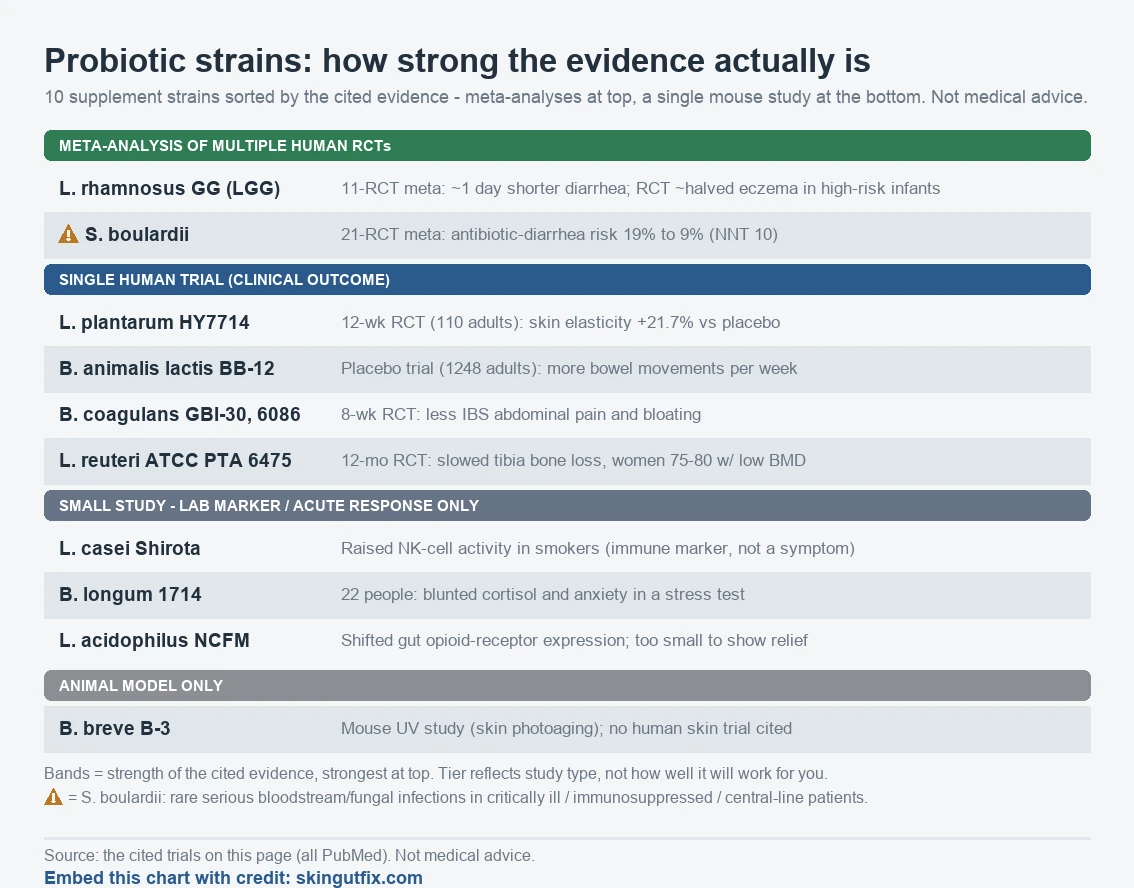
"Clinically studied" hides a huge range. Of these ten strains, only two — L. rhamnosus GG and S. boulardii — are backed by meta-analyses of multiple human trials. Four rest on a single human trial, three on a small study of a lab marker or short-term response rather than a clinical outcome, and one (B. breve B-3) on mice alone. The strain code on the label tells you which; the marketing above it usually doesn't.
Lactobacillus Strains
Lactobacillus is the genus I recognize fastest now — it's in most of the bottles that have cycled through my cabinet, usually trailing a strain code I have to squint at. Here's what's actually documented for the specific ones that keep showing up on labels I've tested.
| Strain Name | Primary Mechanism | Research Focus | Key Findings / Data |
|---|---|---|---|
| Lactobacillus rhamnosus GG (LGG) | High gastrointestinal survival and mucosal adhesion. | Acute diarrhea duration and atopic dermatitis prevention in high-risk infants. | A meta-analysis of 11 RCTs (n=2444) found LGG cut diarrhea duration by a mean of 1.05 days (95% CI -1.7 to -0.4) vs. placebo (PubMed). Separately, in infants from high-allergy-risk families given LGG prenatally and for 6 postnatal months, atopic eczema by age 2 occurred in 23% (15/64) vs. 46% (31/68) on placebo — RR 0.51 (95% CI 0.32-0.84) (PubMed). |
| Lactobacillus plantarum HY7714 | Regulation of serine palmitoyltransferase (SPT) and ceramidase mRNA levels, shown in a companion cell/mouse study (PubMed). | Skin hydration and anti-photoaging. | 12-week RCT (110 volunteers, ages 41-59): skin elasticity improved 13.17% at 4 weeks and 21.73% at 12 weeks vs. placebo (p<0.05, then p<0.01) (PubMed). |
| Lactobacillus acidophilus NCFM | Modulation of colonic mucosal mu-opioid receptor (MOR) expression. | Functional abdominal pain and visceral pain sensation. | In a 21-day trial in 20 women with abdominal pain, NCFM alone (not combined with B-LBi07) induced colonic MOR mRNA and protein expression — a proposed mechanism for modulating pain sensation, though the trial was too small to confirm a symptom difference (PubMed). |
| Lactobacillus reuteri ATCC PTA 6475 | Proposed gut-bone axis effect; exact human mechanism not established in the trial cited. | Bone density and age-associated bone loss. | 12-month RCT in women aged 75-80 with low bone mineral density: L. reuteri 6475 reduced loss of total tibia volumetric BMD vs. placebo (-0.83% vs. -1.85%; mean difference 1.02%, 95% CI 0.02-2.03) (PubMed). |
| Lactobacillus casei Shirota | Activation of cytotoxic lymphocytes and NK cell activity. | Immune (NK-cell) response in smokers. | In healthy male smokers, daily LcS intake for 3 weeks significantly increased NK cell activity vs. placebo (P<0.001) (PubMed). |
Bifidobacterium Strains
Bifidobacterium took longer to click for me — less front-of-box marketing, more buried in the fine print. These are the three strains I kept running into once I started actually reading past the hero claim on the label.
| Strain Name | Primary Mechanism | Research Focus | Key Findings / Data |
|---|---|---|---|
| Bifidobacterium animalis subsp. lactis BB-12 | Colonizes the gut and shifts stool transit; barrier/pathogen-inhibition properties are reported in vitro, not tested in the trial cited. | Bowel regularity in adults with low defecation frequency. | In 1248 adults with low defecation frequency, 4 weeks of BB-12 significantly raised the odds of gaining at least 1 additional bowel movement per week compared with placebo (PubMed). |
| Bifidobacterium longum 1714 | Psychobiotic modulation of the gut-brain axis. | Stress response and cognitive performance. | In 22 healthy volunteers exposed to a socially evaluated cold-pressor stress test, B. longum 1714 attenuated the rise in cortisol and subjective anxiety vs. placebo (PubMed). |
| Bifidobacterium breve B-3 | Suppression of UV-induced transepidermal water loss (TEWL) and epidermal thickening. | Skin photoaging and UV protection (mouse model). | In hairless mice given 7 weeks of chronic UVB exposure, B. breve B-3 suppressed the UV-induced changes in TEWL, hydration, and epidermal thickening, and limited damage to tight-junction and basement-membrane structure (PubMed). |
Other Probiotic Organisms
And then there's the stuff that doesn't fit neatly in either bucket — a yeast and a spore-forming bacterium, both of which showed up in supplements that promised to survive stomach acid better than the rest. That particular claim turned out to be the one part of the label actually worth trusting.
| Strain Name | Primary Mechanism | Research Focus | Key Findings / Data |
|---|---|---|---|
| Saccharomyces boulardii | Non-pathogenic yeast; survives gastric acidity, thought to inhibit toxins and support microbiota diversity. | Antibiotic-associated diarrhea (AAD) prevention. | Meta-analysis of 21 RCTs (n=4780): S. boulardii cut AAD risk from 18.7% to 8.5% (RR 0.47, 95% CI 0.38-0.57; NNT 10) (PubMed). |
| Bacillus coagulans GBI-30, 6086 | Spore-forming bacterium; survives high heat and stomach acid. | IBS symptoms (abdominal pain and bloating). | 8-week RCT: B. coagulans GBI-30, 6086 significantly improved self-reported abdominal pain and bloating scores for all 7 weekly comparisons vs. placebo (P<0.01) (PubMed). |
Last verified: 2026-07-12
One more thing, because this is technically a supplement page and I'd rather be annoying than irresponsible about it: I'm not a doctor, a nutritionist, or a microbiologist — just someone with a bathroom cabinet full of these bottles and a spreadsheet that's gotten a little out of hand. A strain working in a clinical trial isn't the same as a strain working for your specific gut, and if you're pregnant, nursing, immunocompromised, on medication, or have a central line or feeding tube, please loop in your doctor or pharmacist before adding any of these — that part isn't optional. Saccharomyces boulardii specifically has been linked to rare but serious bloodstream and fungal infections in people who are already critically ill, immunosuppressed, or have a central venous catheter in place, so that's the one I'd flag hardest to run past a professional first — not past me.
Sources
- Meta-analysis: Lactobacillus GG for treating acute gastroenteritis in children - PubMed
- Probiotics in primary prevention of atopic disease: a randomised placebo-controlled trial - PubMed
- Clinical Evidence of Effects of Lactobacillus plantarum HY7714 on Skin Aging - PubMed
- Effect of oral administration of Lactobacillus plantarum HY7714 on epidermal hydration in UVB-irradiated hairless mice - PubMed
- Lactobacillus acidophilus NCFM affects colonic mucosal opioid receptor expression in patients with functional abdominal pain - PubMed
- Lactobacillus reuteri reduces bone loss in older women with low bone mineral density - PubMed
- Daily intake of Lactobacillus casei Shirota increases natural killer cell activity in smokers - PubMed
- Effect of the probiotic strain Bifidobacterium animalis subsp. lactis, BB-12, on defecation frequency - PubMed
- Bifidobacterium longum 1714 as a translational psychobiotic - PubMed
- Effect of Bifidobacterium breve B-3 on skin photoaging induced by chronic UV irradiation in mice - PubMed
- Systematic review with meta-analysis: Saccharomyces boulardii in the prevention of antibiotic-associated diarrhoea - PubMed
- Bacillus coagulans significantly improved abdominal pain and bloating in patients with IBS - PubMed